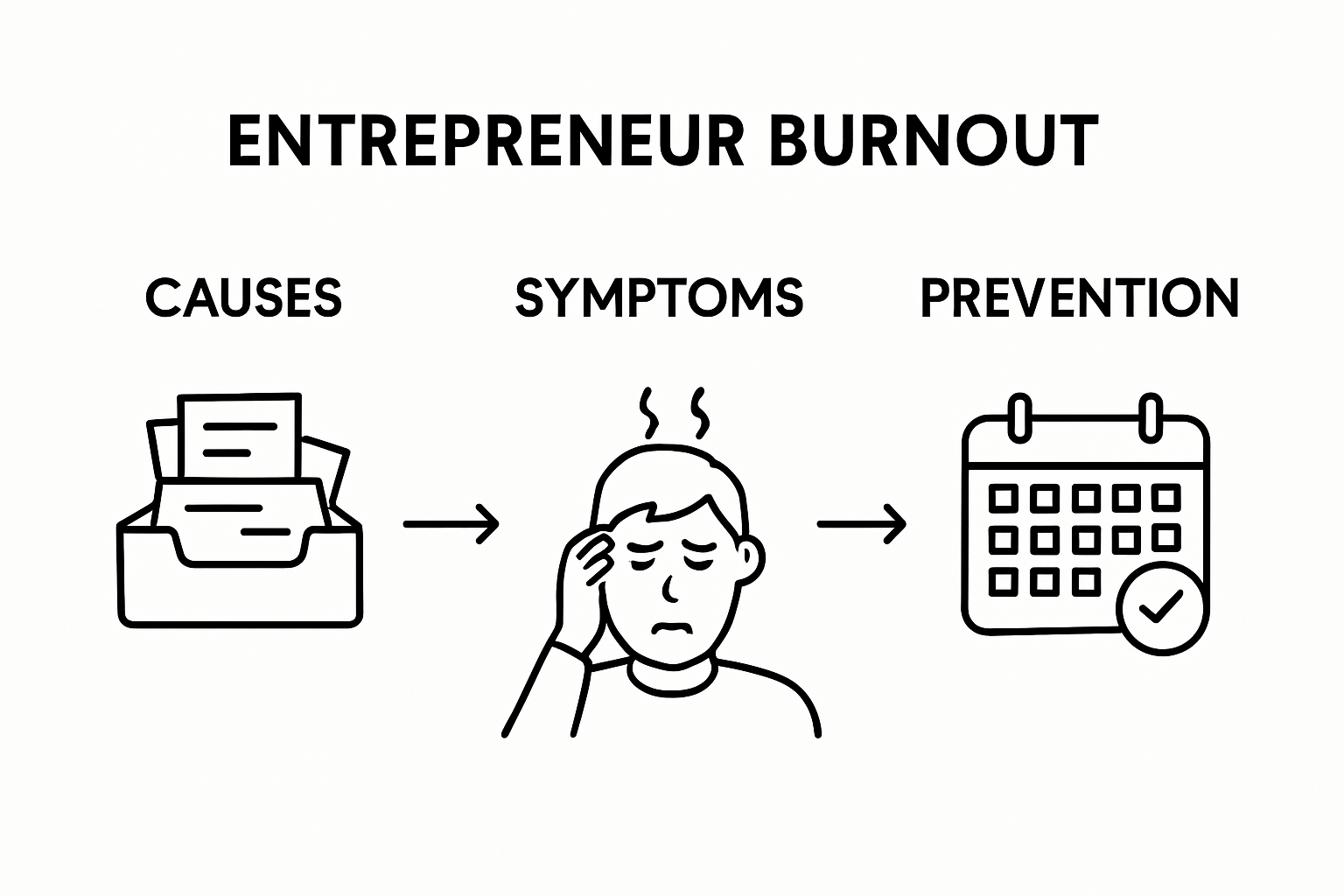
Over one in four American entrepreneurs will struggle with burnout at some point in their journey. This problem goes far beyond simple tiredness, deeply impacting business growth, creativity, and personal health. Understanding what truly causes burnout—while letting go of common myths—can make the difference between long-term failure and sustainable success. This guide reveals the realities behind burnout, helping every American entrepreneur recognize warning signs and take steps that truly protect their well-being.
Table of Contents
- Burnout Defined: Causes and Common Myths
- Types of Burnout in Entrepreneurship
- Recognizing Symptoms and Warning Signs
- Consequences for Business and Well-Being
- Effective Strategies to Prevent Burnout
Key Takeaways
| Point | Details |
|---|---|
| Burnout is a Systemic Issue | Burnout signals underlying organizational problems rather than individual weakness, and it often emerges from misalignment between personal values and workplace conditions. |
| Types of Entrepreneurial Burnout | Entrepreneurs face distinct forms of burnout, such as passion-driven and isolation-induced burnout, which differ from traditional workplace exhaustion. |
| Symptoms and Warning Signs | Symptoms like emotional depletion and cognitive fog often develop gradually, making early recognition crucial to prevent escalation. |
| Holistic Prevention Strategies | Effective burnout prevention requires establishing boundaries, practicing self-care, and fostering support networks to enhance both personal resilience and workplace dynamics. |
Burnout Defined: Causes and Common Myths
Entrepreneurs often misunderstand burnout as simple exhaustion, but it’s a complex psychological syndrome with deep organizational roots. Research from Psychology Today reveals burnout isn’t a personal weakness, but a critical signal indicating systemic workplace challenges that demand meaningful transformation.
Understanding burnout requires dismantling several persistent myths. Contrary to popular belief, burnout isn’t exclusively about working too many hours or lacking personal resilience. Groundbreaking research by Professor Jari Hakanen demonstrates that genuine work engagement actually protects against burnout, while compulsive overworking significantly increases risk. The key distinction lies in motivation and alignment with personal values.
The most dangerous myths about burnout typically include:
- Burnout only happens to weak professionals
- Passionate people can’t experience burnout
- Working longer hours is the primary cause
- Burnout is just extreme tiredness
- Individual personality determines burnout risk
In reality, burnout emerges from complex interactions between personal experience and organizational structures. It represents a profound misalignment between an individual’s energy, expectations, and workplace environment. Recognizing these nuanced dynamics is the first step toward prevention and sustainable professional wellness.
Types of Burnout in Entrepreneurship
Entrepreneurial burnout isn’t a one-size-fits-all experience but a nuanced condition with multiple manifestations. Research from the US Chamber of Commerce reveals that entrepreneurs face unique burnout challenges, stemming from complex psychological and professional dynamics that differ significantly from traditional workplace exhaustion.
The primary types of burnout entrepreneurs encounter include:
- Passion-Driven Burnout: Occurs when excessive commitment leads to emotional depletion
- Isolation-Induced Burnout: Results from limited social connections and solo entrepreneurial journey
- Overachievement Burnout: Emerges from constant pressure to exceed performance expectations
- Strategic Fatigue Burnout: Happens when continuous decision-making overwhelms cognitive resources
- Value Misalignment Burnout: Develops when business activities contradict personal core values
Innovative research from Aalto University suggests that entrepreneurs might experience a unique form of ‘positive workaholism’, where autonomy and engagement can paradoxically protect against traditional burnout symptoms. This counterintuitive finding highlights the complex relationship between entrepreneurial motivation and psychological well-being, demonstrating that burnout isn’t merely about working hours, but about the quality of work experience and personal alignment.
Recognizing Symptoms and Warning Signs
Burnout is a complex psychological state that sneaks up gradually, often catching entrepreneurs off guard. Research from occupational health studies reveals burnout as a critical occupational phenomenon, characterized by three primary dimensions: emotional exhaustion, depersonalization, and diminished personal accomplishment.
Entrepreneurs should be vigilant about the following warning signs:
- Physical Exhaustion: Persistent fatigue that sleep cannot resolve
- Emotional Depletion: Feeling emotionally drained and detached
- Cognitive Fog: Difficulty concentrating and making decisions
- Motivation Collapse: Sudden disinterest in previously exciting business activities
- Cynicism: Developing a persistently negative outlook toward work
- Productivity Decline: Reduced efficiency and increased procrastination
Psychological research challenges the misconception that burnout is a personal weakness, highlighting it as a complex systemic response to prolonged workplace stress. The most insidious aspect of entrepreneurial burnout is its gradual progression. What might start as occasional stress can evolve into a comprehensive breakdown of professional and personal well-being if left unaddressed. Recognizing these symptoms early allows entrepreneurs to implement strategic interventions, protecting both their mental health and business sustainability.

Consequences for Business and Well-Being
Entrepreneurial burnout extends far beyond personal discomfort, creating profound ripple effects across both professional and personal domains. Research highlighting organizational impacts reveals burnout as a systemic challenge that undermines business performance and individual potential, transforming what might seem like a personal struggle into a critical business sustainability issue.
The consequences of unchecked burnout manifest in multiple devastating ways:
- Strategic Decision Impairment: Reduced cognitive clarity leading to poor business choices
- Innovation Paralysis: Diminished creative problem-solving capabilities
- Team Dynamics Erosion: Negative emotional states influencing workplace relationships
- Financial Performance Decline: Decreased productivity and increased operational inefficiencies
- Personal Health Deterioration: Chronic stress triggering potential long-term medical complications
- Entrepreneurial Motivation Collapse: Complete disengagement from business vision
Aalto University’s research underscores that entrepreneurs face unique challenges in managing work demands and recovery time, highlighting the intricate balance between professional passion and personal well-being. The most significant risk lies not in momentary exhaustion, but in the cumulative effect of sustained stress that gradually erodes an entrepreneur’s resilience, creativity, and fundamental capacity to drive business growth.
Effective Strategies to Prevent Burnout
Burnout prevention requires a holistic approach that addresses both personal resilience and systemic workplace challenges. Psychology Today research highlights the critical need for strategic interventions that align work with personal values, moving beyond simplistic solutions to create meaningful change in entrepreneurial well-being.
Key strategies entrepreneurs can implement include:
- Establish Clear Boundaries: Set realistic work hours and protect personal time
- Practice Systematic Self-Care: Develop consistent physical and mental health routines
- Build Support Networks: Create connections with fellow entrepreneurs and mentors
- Implement Delegation Systems: Learn to distribute tasks and avoid micromanagement
- Regular Goal Reassessment: Continuously align business objectives with personal vision
- Develop Stress Management Techniques: Incorporate meditation, exercise, and mindfulness practices
The US Chamber of Commerce recommends developing a flexible mindset as a crucial approach to combating entrepreneurial burnout, emphasizing that prevention is not about eliminating stress entirely, but about building robust psychological resilience. The most effective burnout prevention strategy involves creating a dynamic, adaptive approach that recognizes the unique challenges of entrepreneurial life while maintaining personal well-being as a fundamental priority.
Take Control of Entrepreneurial Burnout and Thrive
Burnout is more than just feeling tired. It is a deep emotional exhaustion that impacts your motivation, decision-making, and the very core of your business success. If you resonate with terms like emotional depletion, value misalignment burnout, or strategic fatigue burnout from the article, you understand the critical need to protect your energy and align your work with your personal values.
At SimoneCR.com, we specialize in helping entrepreneurs like you overcome these exact challenges by integrating inner work with proven business strategies. Our holistic approach focuses on self-leadership, building confidence, and mastering money mindset to prevent burnout before it takes over. Don’t let burnout slow you down or break your business growth.
Ready to shift from surviving to thriving? Join the movement with Join The Freedom Club today and equip yourself with the tools to sustain success without sacrificing your well-being. Take the first step toward reclaiming your passion and creating a business that supports your life, not the other way around.
Frequently Asked Questions
What are the primary causes of burnout in entrepreneurs?
Burnout in entrepreneurs often stems from factors such as excessive commitment leading to emotional depletion, isolation due to limited social connections, constant pressure to exceed expectations, overwhelming decision-making, and misalignment between business activities and personal values.
How can entrepreneurs recognize the signs of burnout?
Entrepreneurs can recognize burnout through symptoms such as persistent physical exhaustion, emotional depletion, cognitive fog, sudden disinterest in work, cynicism, and a decline in productivity.
What are the consequences of unchecked burnout for entrepreneurs?
Unchecked burnout can lead to strategic decision impairment, diminished innovation, eroded team dynamics, decreased financial performance, personal health deterioration, and a collapse of entrepreneurial motivation.
What effective strategies can entrepreneurs use to prevent burnout?
Effective strategies for preventing burnout include establishing clear boundaries, practicing systematic self-care, building support networks, implementing delegation systems, regularly reassessing goals, and developing stress management techniques.